How Can Toy Factories Standardize Faster and Cleaner Unboxing?
A faster unboxing experience depends on decisions made long before the toy reaches a customer. Factories need repeatable materials, clear work instructions, controlled fastening tension, and testing that links production quality to the way the package opens at home. Without a standard, one operator may leave a loop loose, another may over-tighten it, and a third may hide the release tab behind the tray. Standardization turns a promising packaging idea into a reliable system that can be used across shifts, products, and suppliers.
What should a fastening standard include?
The standard should begin with the function of each restraint. It must state where the toy is supported, which movements must be prevented, and how the customer releases the package. Drawings should define cord length, routing, slot dimensions, lock type, tab position, and acceptable tension. Photographs of correct and incorrect assemblies are useful at the workstation because operators can compare the actual package with a visible reference.
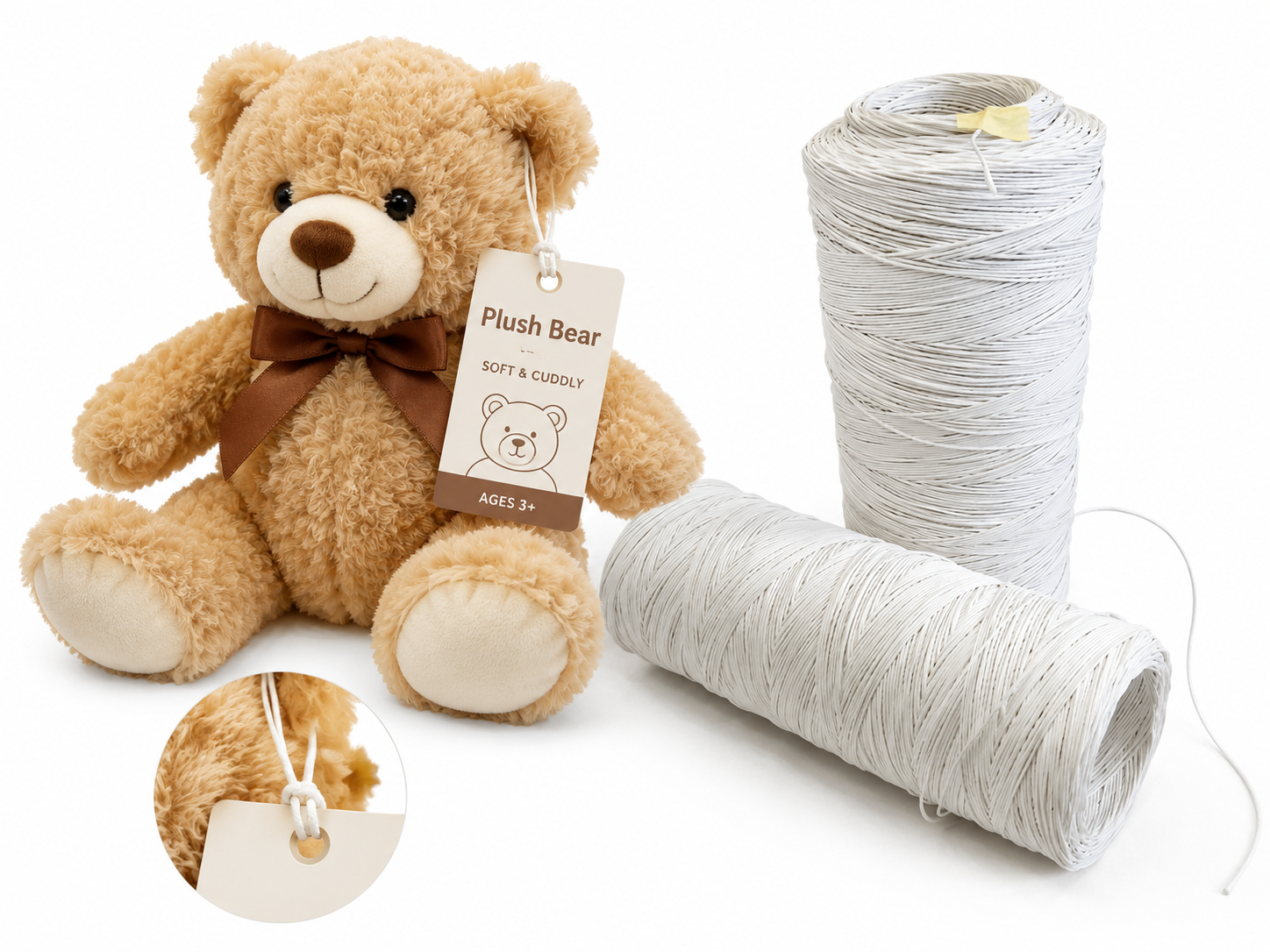
Material requirements should be measurable. For paper rope biodegradable twine, the document can specify diameter range, tensile strength, elongation, surface finish, color, moisture condition, and roll or bundle format. It should also identify approved suppliers and incoming inspection methods. A generic description such as “paper cord” is not enough when variations can change line speed or release force.
How can the line apply restraints consistently?
Consistency improves when the process removes unnecessary judgment. Pre-cut lengths, marked tray slots, and fixed routing paths reduce variation. A simple fixture can hold the toy and tray in the correct position while the operator secures the loop. For higher volumes, feeding and cutting equipment can deliver a repeatable cord length, while a tying or locking station can control tension.
The operation should fit naturally into the line sequence. If the restraint is applied too early, later assembly steps may disturb it. If it is applied too late, access may be poor. Time studies should compare alternative workstation layouts and confirm that operators can complete the task without awkward reaching or repeated package rotation. The best method protects both throughput and ergonomics.
Which quality checks matter most?
Not every package needs a destructive test, but every package should receive a quick visual check. The operator or inspector can confirm that each loop follows the correct path, the tab is visible, the toy is not compressed, and no cord crosses a delicate feature. Sampling plans can then measure pull force, loop tension, and release performance at defined intervals.
Quality teams should track failure modes instead of only pass rates. Examples include hidden tabs, over-tight loops, cord fraying, torn slots, loose accessories, cosmetic marks, and excessive opening force. When paper rope biodegradable twine behaves differently after humidity changes, the factory can add conditioning controls, storage limits, or machine adjustments rather than treating each failure as an isolated event.
How should factories validate changes?
Any change to cord supplier, paperboard grade, tray tooling, lock geometry, or machine setting can affect both transport security and customer release. A change-control process should define when revalidation is required. Small pilot batches can be tested for line performance, vibration resistance, drop behavior, shelf presentation, and tool-free opening before full production begins.
User testing should remain part of validation. A factory test may confirm that the package survives shipping, but only customers reveal whether the opening sequence is obvious. Participants should receive the package without coaching. Record the time to locate the first tab, total release time, incorrect actions, tool use, and accidental damage. These results can be compared with the previous design and used as release criteria.
How can one standard work across several toy formats?
A modular standard is more practical than a single rigid design. The same release icon, tab principle, cord specification, and quality methods can be used across dolls, vehicles, plush toys, and electronic products. Product-specific drawings can change loop length, support location, and tray geometry while preserving the familiar customer action. This reduces training needs and helps buyers recognize a consistent unboxing experience across a brand.
Supplier alignment is equally important. Packaging converters, toy assemblers, cord suppliers, and testing laboratories should use the same revision-controlled documents. Shared samples and approval procedures reduce misunderstandings. Performance data should be stored by material lot and production run so problems can be traced quickly.
What performance indicators show that the system works?
Useful indicators include fastening time per unit, material consumption, line rework, transport failures, average opening time, tool use, damage during opening, and customer complaints about ties. Sustainability indicators may include reduction in metal or plastic components, material separation steps, and packaging weight. These measures allow the team to improve the system based on evidence instead of appearance alone.
A mature standard connects factory efficiency with customer convenience. It ensures that paper rope biodegradable twine is not merely added to an old wire-based design, but is supported by suitable tray geometry, controlled tension, visible release points, and validated work instructions. The result is cleaner production, more predictable shipping performance, and an opening experience that lets families reach the toy quickly without complicated untwisting, cutting, or searching.
Tags: production-line fastening standard, automatic paper rope tying, quality-control pull test, wire-free toy mounting, sustainable toy packaging, biodegradable paper twine
READ MORE:
- Como as fábricas podem padronizar uma abertura mais rápida e limpa?
- Como a geometria de puxar pode reduzir danos e frustração?
- Como uma aba de liberação pode facilitar a abertura sem ferramentas?
- Como um sistema de cordão de papel pode substituir arames torcidos?
- Como as marcas podem tornar a abertura de brinquedos menos complicada?
- How Can Child-Safe Pull Geometry Reduce Damage and Unboxing Frustration?
- How Should a Tool-Free Release Tab Be Designed for Safer Toy Unboxing?
- How Can Paper-Rope Fasteners Replace Twisted Wires in Toy Packaging?
- How Can Toy Brands Reduce Complicated Wire Removal During Unboxing?


