How Can Child-Safe Pull Geometry Reduce Damage and Unboxing Frustration?
Child-safe pull geometry describes how a customer’s fingers approach a release point, the direction in which the tab moves, and what happens to the toy when the restraint opens. These relationships determine whether a package feels controlled or awkward. A tab may have suitable material and strength, yet still create frustration if it forces the hand into a narrow space or sends the toy forward unexpectedly. Geometry should therefore be designed around natural hand movement, predictable load transfer, and clear separation between the customer, the restraint, and delicate product surfaces.
What is a natural pull direction?
Most users find a straight pull easier to understand than a twisting or sideways action. The tab should face the customer and travel away from the toy, preferably along a path that is not blocked by carton walls. The pulling hand should have space for the wrist and knuckles. If the package requires a steep angle, users may bend the tab, tighten the restraint, or apply force to the wrong component.
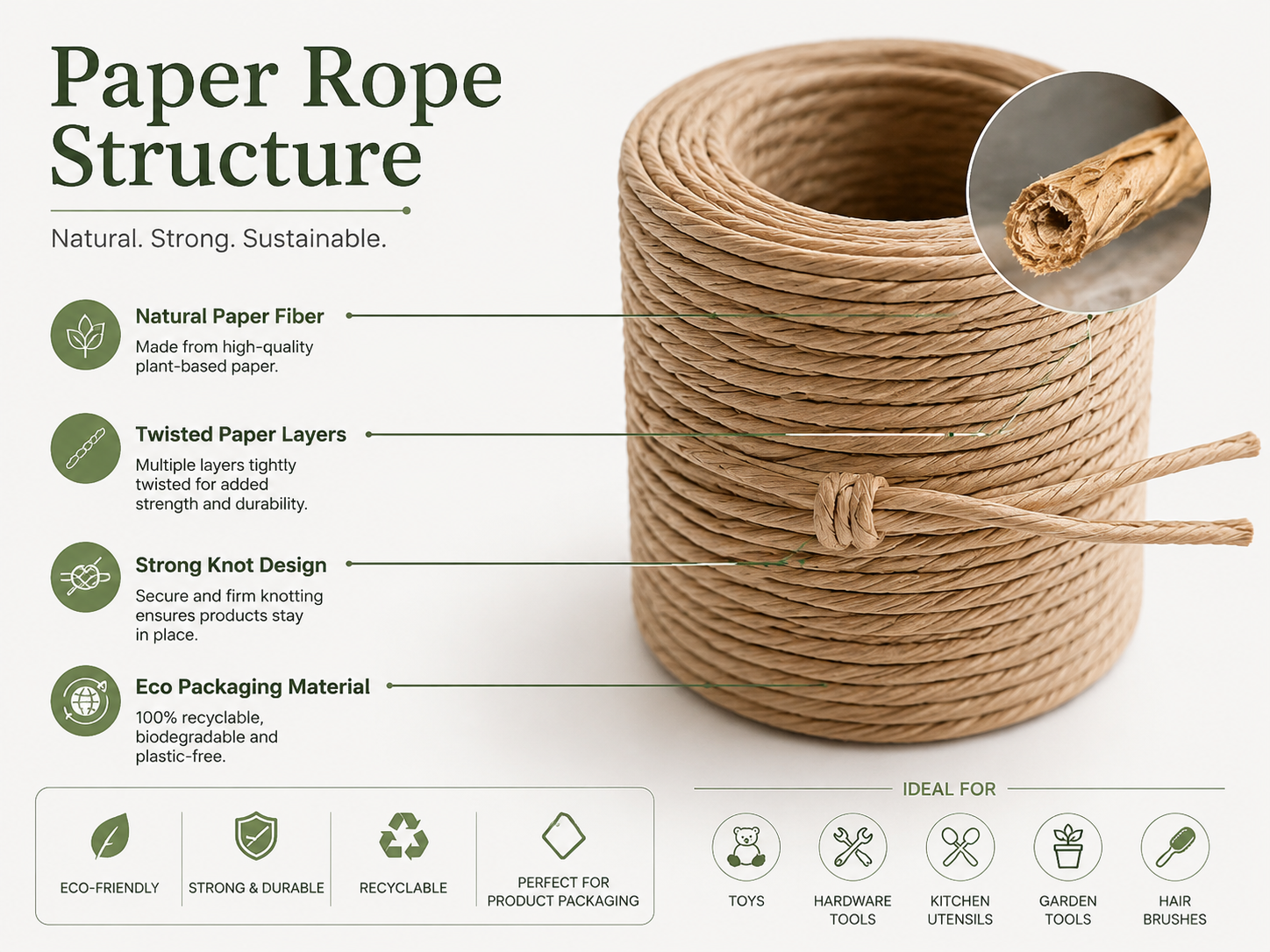
The cord path should reinforce that motion. With paper rope biodegradable twine, the loop can pass through rounded tray slots and connect to a paper lock positioned behind the tray. Pulling the tab should release or loosen the lock before the cord moves across the toy. This order reduces rubbing and prevents the loop from marking painted or textile surfaces.
How can the released toy remain stable?
A restraint should not be the only feature keeping the toy inside the package. Molded supports, side walls, and fitted recesses can hold the product after the loop is loosened. This lets the customer remove restraints first and lift the toy second. It also prevents a heavy toy from falling toward the user when the final tab is pulled.
For products with several restraints, designers should study the load after each release. The first pull should not transfer excessive weight to a fragile arm, wheel, or accessory. Numbering the tabs can establish a safe sequence. In some cases, releasing the upper restraint before the base is safer; in others, the base should be freed first. Physical prototypes are essential because computer drawings may not show how the product shifts under gravity.
Which dimensions should be controlled?
Important dimensions include tab width, grip length, clearance around the tab, slot radius, loop length, and the distance between the restraint and the product. Each dimension should have a tolerance that the factory can maintain. A very small slot may increase friction, while an oversized slot may allow the cord to move during transport. A short loop may compress the product, and a long loop may fail to control it.
Engineers should also define the pull angle and maximum travel. A tab that travels too far can strike another package component or cause the user’s hand to move suddenly. A controlled stop can make the release feel more deliberate. When paper rope biodegradable twine is used, the specification should consider normal variations in fiber diameter and flexibility so the geometry remains reliable across production batches.
How does geometry improve safety for children and adults?
The primary opening action should be intended for an adult, but the package should minimize hazards if a child is nearby. The release should not create sharp wire ends, spring-loaded pieces, or small plastic locks. Captured paper components can remain connected to the tray. The pull path should direct the hand away from the child and keep the toy supported until it is intentionally lifted.
Accessibility is also part of safety. Older adults and users with limited dexterity may struggle with tiny knots or hidden clips. A larger grip area, moderate pull force, and one-direction action can reduce strain. Clear contrast and tactile cues help users locate the release point without relying only on fine print.
How can geometry be validated on the packaging line?
Validation should include both product testing and process testing. In user trials, record incorrect pulls, hand collisions, torn tabs, sudden product movement, and total opening time. In production trials, measure whether operators place the loop consistently and whether the tab stays visible after the package is closed. A design that works only when assembled perfectly needs either stronger controls or simpler geometry.
Factories can use gauges for loop length, slot position, and tab exposure. Pull-force sampling can identify changes in paperboard, cord, or machine settings. Photographic standards at the workstation can show correct routing. These controls prevent small assembly variations from becoming customer-facing problems.
How does good geometry support standardization?
Once the geometry is proven, it can become a reusable platform across a toy range. Different products may use different loop lengths or tray shapes, but the tab icon, pull direction, lock principle, and quality checks can remain consistent. Customers then learn one opening language, while factories reduce training and tooling complexity.
This platform should be documented as a production-line fastening standard covering material, dimensions, routing, assembly, testing, and release performance. By combining stable geometry with paper rope biodegradable twine, toy brands can reduce scratches, loose components, excessive opening force, and the uncertainty that makes traditional wire removal so frustrating.
Tags: child-safe pull geometry, anti-scratch toy tie, quick-release paper loop, packaging line optimization, toy factory fastening service, biodegradable paper twine
READ MORE:
- Como as fábricas podem padronizar uma abertura mais rápida e limpa?
- Como a geometria de puxar pode reduzir danos e frustração?
- Como uma aba de liberação pode facilitar a abertura sem ferramentas?
- Como um sistema de cordão de papel pode substituir arames torcidos?
- Como as marcas podem tornar a abertura de brinquedos menos complicada?
- How Can Toy Factories Standardize Faster and Cleaner Unboxing?
- How Should a Tool-Free Release Tab Be Designed for Safer Toy Unboxing?
- How Can Paper-Rope Fasteners Replace Twisted Wires in Toy Packaging?
- How Can Toy Brands Reduce Complicated Wire Removal During Unboxing?


